A cooling fan that runs constantly, never engages, or operates at the wrong speed often triggers a parts order for the control module. In our experience, a significant share of those modules were never the root cause — corroded grounds, chafed harness sections, or failed relays upstream had already compromised the circuit.
Symptoms That Point to Electrical, Not Mechanical, Failure
Intermittent fan operation during heavy traffic but normal behavior on open roads suggests a thermal or voltage-related fault rather than a seized motor. A fan that spins freely by hand but does not respond to commanded duty cycle almost always warrants circuit analysis before any component swap.
- Fan runs at full speed regardless of coolant temperature
- No fan activity despite confirmed overheating condition
- Module-related codes that return immediately after replacement
- Visible corrosion at the module connector or ground strap
Structured Wiring Verification
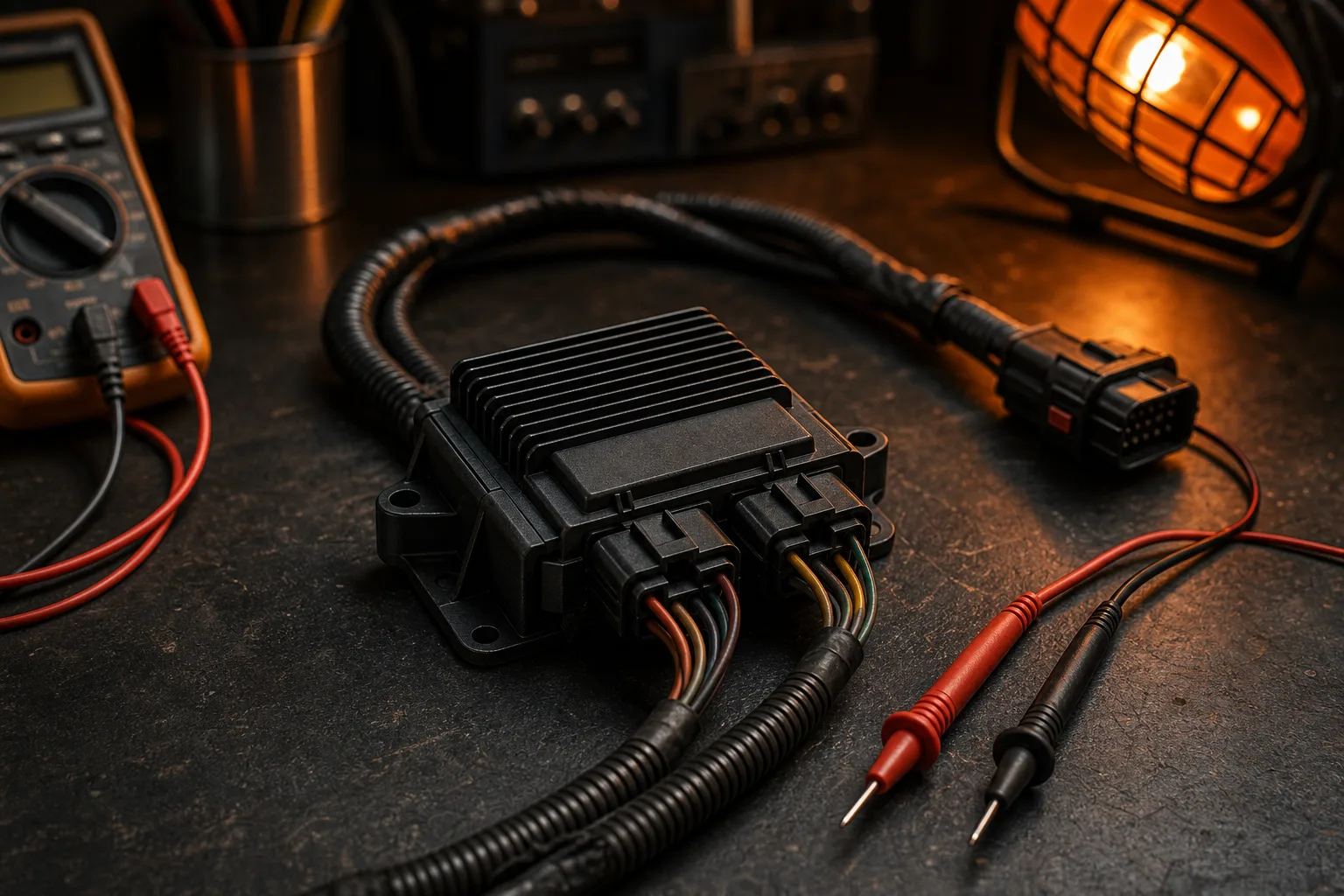
We start with a visual inspection of the harness from the module back to the fuse panel and engine ground points. Pin fitment at the connector, moisture intrusion, and previous repair splices are documented before any pin-out testing begins.
Voltage Drop and Ground Path Testing
Supply voltage measured at the module under load should match battery voltage within a narrow tolerance. Ground-side voltage drop above specification indicates a compromised return path — often at a shared engine block ground that also serves other accessories. Cleaning and re-torquing the ground bolt resolves many cases without replacing any electronic component.
Relay and Fuse Panel Considerations
Fan circuits frequently pass through multiple relays depending on vehicle speed and A/C demand. Testing relay coil resistance and switch continuity under load reveals failures that scan tools misattribute to the module itself. We also verify fuse ratings match specification; an oversized fuse can mask a short until wiring insulation fails entirely.
When Module Replacement Is Justified
After confirming clean power, solid ground, intact wiring, and functional relays, module replacement becomes a data-driven decision. We record pre- and post-repair fan duty cycle response to coolant temperature and A/C pressure inputs. This documentation helps owners understand why the module was necessary and provides a baseline for future comparison.